
Food Nourishment Explains & Changes Your Behaviors
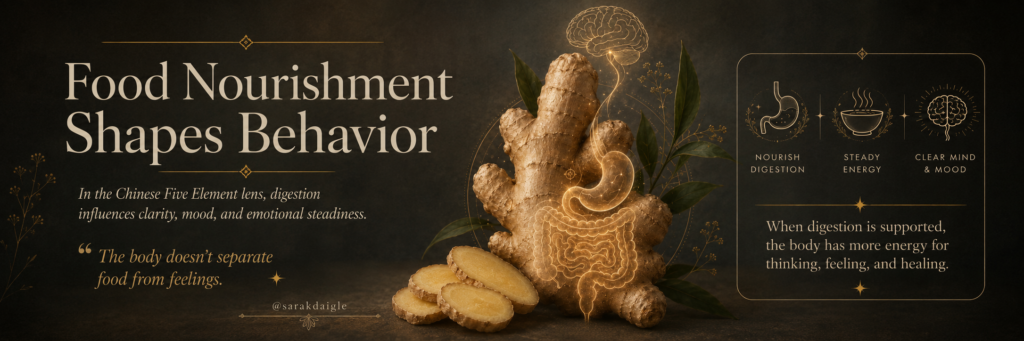
Your body doesn’t just digest food. It digests everything—your stress, your emotions, the argument you had this morning, the deadline pressing on your chest.
And when your digestion can’t keep up, it shows you. Not with a polite memo, but with bloating, brain fog, rage you can’t explain, or exhaustion that sleep doesn’t fix.
Here’s what most people miss: the food you eat doesn’t just fuel your body. It directly shapes how you feel, think, and act.
Not in some vague “you are what you eat” way. In a very specific, trackable, elemental way.
Your Digestive System Is Your Emotional Center
In Traditional Chinese philosophy, your Spleen and Stomach (what we call your digestive system) sit at the center of everything. They don’t just break down food—they transform it into the energy that powers your thoughts, your moods, your ability to get through the day without snapping at someone.
When your digestion is strong, you can:
- Think clearly without overthinking
- Feel steady instead of overwhelmed
- Nourish yourself without guilt or second-guessing
- Move through your day with actual energy, not just caffeine and willpower
When your digestion is weak or overloaded, you get:
- Mental fog and obsessive worry loops
- Bloating, heaviness, sluggishness
- Emotional reactivity—small things feel huge
- The constant need to snack or the complete loss of appetite
- Difficulty making decisions or setting boundaries
The body may be telling a larger story. And that story often starts with how you’re feeding yourself.
How Food Creates Emotions (And Behaviors)
Your digestive system is like a factory. When it’s running smoothly, it takes in raw materials (food) and transforms them into usable energy. But when the factory gets backed up—too much input, not enough processing power, wrong materials coming in—everything downstream suffers.
Here’s how it works:
Cold, Raw, or Hard-to-Digest Foods = Damp Accumulation
Think salads, smoothies, raw vegetables, cold drinks, dairy, fried foods, processed sugars.
These foods require a lot of energy to break down. If your digestive fire is already low (you feel tired, bloated, or have loose stools), these foods pile up faster than your body can process them.
What accumulates: Dampness.
Dampness feels like:
- Bloating and puffiness
- Brain fog—like you’re thinking through a cloud
- Heavy limbs, sluggish movement
- Overthinking and worry that won’t stop
- Difficulty making decisions
The behavior pattern:
When dampness builds, you start moving slower. You second-guess yourself. You feel stuck—physically and emotionally. You might overeat to try to “fix” the low energy, which only makes the dampness worse. Or you might lose your appetite entirely because your body knows it can’t process more.
Warm, Cooked, Easy-to-Digest Foods = Clear Energy
Think soups, stews, roasted vegetables, cooked grains, bone broth, ginger tea, warm proteins.
These foods are pre-digested by heat. Your body doesn’t have to work as hard to break them down, which means more energy left over for everything else—thinking, feeling, moving, healing.
What you build: Qi (energy) and Blood (nourishment).
This feels like:
- Mental clarity without the fog
- Steady energy that doesn’t crash
- A calm, grounded emotional state
- The ability to think without spiraling
- Comfort in your own body
The behavior pattern:
When your digestion is strong and nourished, you make better decisions. You don’t react as quickly to stress. You can hold boundaries without guilt. You feel like yourself again.
The Pattern You Might Be Living
Let’s say you’re dealing with this cluster:
- Bloating after every meal
- Overthinking everything, especially at night
- Feeling too tired to do anything, but too wired to rest
- Snapping at people over small things
This belongs to damp Earth (weak digestion, accumulated worry) with some Wood excess (stuck anger, Liver frustration).
What’s happening beneath the surface:
Your digestive system is overwhelmed. Maybe you’re eating on the go, cold foods, too much sugar or dairy. Maybe you’re eating while stressed (which shuts down digestion). Your body can’t transform the food into clean energy, so it becomes dampness—sludge that clogs the system.
That dampness creates the bloating. But it also creates the brain fog and obsessive worry. In Chinese philosophy, the Spleen (digestion) governs thinking. When it’s overloaded, your thoughts get sticky. You loop. You ruminate. You can’t let things go.
And because your body isn’t getting real nourishment from the food you’re eating, you’re running on empty. That’s where the anger comes in. Your Liver (which governs anger and boundary-setting) gets frustrated when the body isn’t resourced. It’s trying to move energy forward, but there’s no clean fuel to work with.
So you snap. You feel irritable for “no reason.” You have no patience for things that wouldn’t normally bother you.
One symptom can be random. A cluster is a pattern.
Food as Emotional Medicine
Here’s the part that changes everything: you can shift your emotional state by changing how you eat.
Not through restriction or willpower. Through nourishment that your body can actually use.
If You’re Dealing with Bloating, Overthinking, and Irritability:
Body Support:
- Start every meal with something warm—ginger tea, warm lemon water, or a few sips of broth.
- Prioritize cooked foods for at least two weeks. Roasted vegetables instead of raw salads. Warm oatmeal instead of cold cereal. Soups and stews over sandwiches.
- Eat slowly. Put your fork down between bites. Let your body register what’s coming in.
- Walk for 10 minutes after eating. This helps your Spleen and Stomach metabolize the meal.
Behavior Shift:
- Stop eating while scrolling, working, or standing at the counter. Sit down. Make it a moment, not a task.
- Notice when you’re eating to soothe worry versus actual hunger. Before you reach for food, place one hand on your belly and ask: Am I hungry, or am I trying to quiet my mind?
Inquiry (Journal Prompt): Place one hand on your stomach. Ask: What have I been trying to digest that isn’t food? What worry or responsibility am I carrying that isn’t mine to hold?
The Deeper Truth
Your body doesn’t separate food from feelings. It processes both through the same system.
When you eat cold, raw, hard-to-digest foods while stressed, your body gets the message: There’s no safety here. We have to conserve energy. We can’t afford to feel everything.
So it shuts down. It accumulates. It builds dampness, stagnation, heat.
But when you eat warm, nourishing, easy-to-digest foods slowly and intentionally, your body gets a different message: We’re safe. We can digest this. We can transform what comes in.
And suddenly, the overthinking quiets. The bloating eases. The anger softens. You’re not fighting yourself anymore.
This symptom sits at the intersection of how you feed yourself and how you feel yourself.
The body rarely speaks from one place alone. And it’s been trying to have this conversation with you all along.